1. Try simple science experiments. An oldie, but a goodie, the baking-soda volcano is a tried and true way to spark fun and creativity during the summer months. When I looked up the instructions, I was shocked at how easy it is. To my surprise, there are countless fun and simple experiments that families can do at home, even without a background in science.
2. Create a family newsletter. Enlist your kids to choose a template from your computer’s office suite. Older kids will be able to quickly learn their way around the program. Younger kids can help take photos and write stories about family adventures, vacations and fun times at home. They can dictate their summer memories to a parent or older sibling. Include a favorite summer recipe. Send your newsletter to family members and friends.
3. Find a pen pal. Celia wants a pen pal so badly she can’t stand it. Her school friend is moving to another state, so we’ll try to arrange a correspondence with her. Celia also has cousins scattered about, but she wants a new friend, preferably in her favorite country, France, so I’m planning to check out pen pal programs such as International Pen Friends. Yes, I’ll monitor her pen pal friendships closely!
4. Make up silly stories. Remember Mad Libs? You can create your own fill-in-the-blank stories. Don’t overthink, just start writing. “Every time we pass by the big house on the corner, we think about the time our pet (animal), (name of favorite teacher), got loose in the neighborhood and ended up eating (favorite food) out of (favorite neighbor)’s refrigerator.”
5. Record your own audiobooks. Let your child read her favorite book while you record it. Save the recording on your computer, and let her listen to her story when she craves down time. If you have several kids, assign each a character.
6. Create your own book series. Start by brainstorming ideas for a character and setting. Then think about what will make your character special. Maybe he or she is an amateur detective or obsessed with baking cupcakes. Older kids can write their stories on the computer, and younger kids can dictate to a parent or an older sibling.
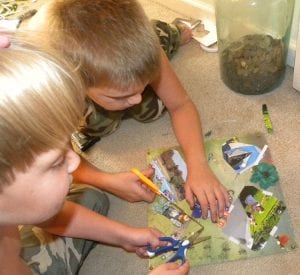
7. Experiment with different art media. Play with different types of paint, from watercolor to oil-based (wear a smock!). Make your own paint. Check out pastels, colored pencils, charcoal and other art supplies. Help your kids discover their favorite ways to express their creativity. Encourage them to make mixed-media masterpieces.
8. Play restaurant. Gather some takeout menus and a play cash register. One child places an order, and the other tallies up the bill. Make your own menu, featuring your kitchen specialties. When a parent returns home from work, let the parent order off the menu.
9. Use word magnets to make sentences. Write words on magnetic tape, or get premade magnetic words. Let your child use a cookie sheet to rearrange the words to make sentences. Challenge your child to make longer and longer sentences.
10. Do laundry together. Crazy but true, laundry is educational! Preschoolers can help you sort laundry by color, find matching socks and count towels and washcloths.
11. Study a foreign language. A whiteboard is as much a summer essential as a beach towel. Every morning, write a word of the day in a favorite language – my child is crazy about French – and use the word all day long. Try working your word of the day into regular conversation and making up silly sentences.
12. Make a reading scrapbook. After reading a fantastic book, encourage your child to draw pictures about the story. Your child can also make up an alternate ending, write a sequel and create a timeline. Keep the book notes in a folder and turn them into a reading scrapbook at the end of the summer.
13. Do jigsaw puzzles together. It may seem old school, but jigsaw puzzles are a great activity for summer downtime. We take puzzles on vacation and work on them in the afternoon when it’s too hot to go to the beach. The best puzzles have crisp, detailed pictures without swaths of solid colors.
Via: http://www.pbs.org/parents/summer/13-ways-to-sneak-learning-into-summer-fun/


 Glue the strip of rubber snuggly around the pipe and hold for a couple minutes. Glue a circle of rubber in the same way to the tip of the PVC (optional. You can also stop it up with some plummer’s epoxy. But you don’t really need to close the end of the 3/4″ pipe).